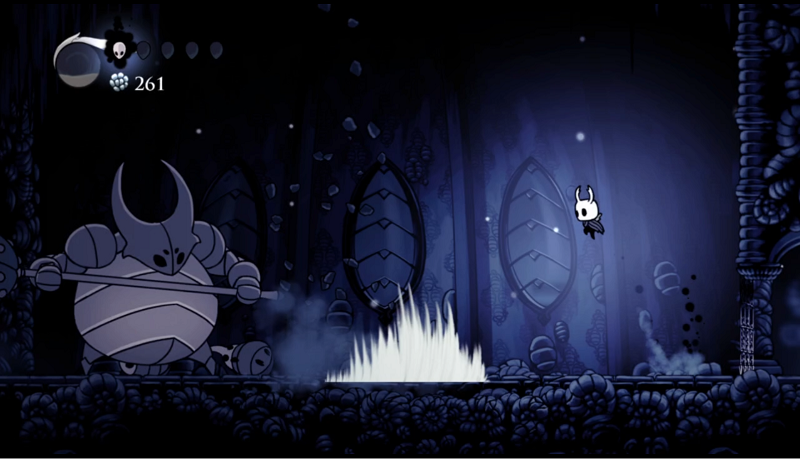
False Knight
Hollow KnightThe hammer impact produces a floor wave whose edge and travel time can be read in a side view.
A ground slam turns one impact into an expanding area threat. It works when the center and growth rate are visible, a valid route exists, and the impact timing tests a skill already taught.
Threat appears
Autoplay is disabled by the reduced-motion setting. Use the timeline slider to inspect the loop.
Tune the signal, the impact center and wave edge, response time, and recovery.
Make the lift, impact point, and exact contact frame distinct from ordinary movement.
Compare wave speed with running, jumping, dodging, and the arena boundary.
Give the slam enough recovery for the successful response to change the fight.
If the signal does not reveal the impact center and wave edge, the hit feels arbitrary.
If timing is tested only at one upgrade level, the pattern can become trivial or unavoidable.
The visible threat must match the active hitbox in space and time.
Keep one response available with abilities the player already has.
Check movement, range, damage, and invulnerability against every phase.
Keep the floor and wave edge visible; slopes and decoration must not mask timing.
Test the strongest available build. If an attack is blocked, make the immunity clear and preserve another useful response.
A slam is the impact; the shockwave is the expanding threat it may create.
The hammer impact produces a floor wave whose edge and travel time can be read in a side view.

Repeated stomps project pressure through a 3D arena and test the jump timing taught by the game.

The axe strike sends out consecutive circular shockwaves. Staggering the rings extends one impact through time as well as across the arena.
Found an inaccuracy or have a suggestion for this page? Propose an edit on GitHub