
Squid
Will You Snail?Squid's boss fight can place spikes and fireworks at positions where it predicts Shelly will be. This forecasts a destination for spawned hazards; Kern's diagram instead commits one traveling shot to a forecast point.
Tavi runs right while Kern marks a position ahead of the run. At release, the forecast freezes and one rune shot travels along that line. Tavi reverses after commitment, so the shot misses; it does not home. The diagram separates the live player position, forecast, locked trajectory, and projectile hitbox.
Tavi moves right. Kern projects a dashed target marker ahead of his current position using the visible direction and speed of travel.
Autoplay is disabled by reduced-motion settings. Scrub to compare live position, forecast, and shot.
Choose a prediction horizon, show what is being forecast, freeze the result, and test a reachable change of course.
Use observed position and recent velocity at a defined sample time. Limit the look-ahead interval and clamp the forecast to reachable arena space; do not secretly read future player input.
Show the forecast marker during aiming, then freeze it at an audible and visible release cue. Spawn the shot on that committed line and keep its velocity fixed unless a separate homing rule is announced.
Test from several approach speeds, distances, and directions. Include the whole player body and projectile radius in clearance checks; leave enough time to reverse or sidestep after the lock.
A perfect forecast that reacts to a turn made after commitment feels like input reading. Derive it from a past sample and make any later correction a separately signaled mechanic.
If players cannot compare their current position with the projected point before release, the attack reads like an unexplained miss or unavoidable hit. Use geometry and timing, not color alone.
An extreme forecast can cover every reachable turn or point beyond the arena. Cap the horizon and test the response at low and high player speeds.
Estimate velocity from two recent positions, smooth noise if needed, and compute target = position + velocity × lead time. Make the sample window and lead time explicit tuning parameters.
The dashed marker is a destination cue, not a damage zone. Collision belongs to the moving shot; it should not fire merely because the player touches the future marker.
Check a standing player, a steady runner, and a runner who reverses just after commitment. Tune projectile travel time and player acceleration together so the intended response stays possible.
Later cycles may shorten the lead time or add a second forecast, but preserve the same lock cue. Combining faster prediction and longer tracking at once hides what changed.
Kern reads the momentum of Tavi's run and stamps a rune where that route would lead. The stone shot obeys the completed mark rather than chasing Tavi's later decision.
Tavi needs only ordinary movement to change course after the lock. If a dodge, dash, or guard is added, decide whether it creates a new escape or merely shortens a window that was already fair without it.
Target lock fixes the player's current position; predictive aiming projects from observed movement. Source tracking keeps turning the firing source, while homing changes a projectile after release. This shot does neither once Kern commits.
Squid's boss fight can place spikes and fireworks at positions where it predicts Shelly will be. This forecasts a destination for spawned hazards; Kern's diagram instead commits one traveling shot to a forecast point.

The glint thrown during Sisyphus Prime's Destroy attack attempts to predict the player's position before exploding. It tests a change of momentum under close-range pressure, whereas Kern's shot exposes its entire projected lane.
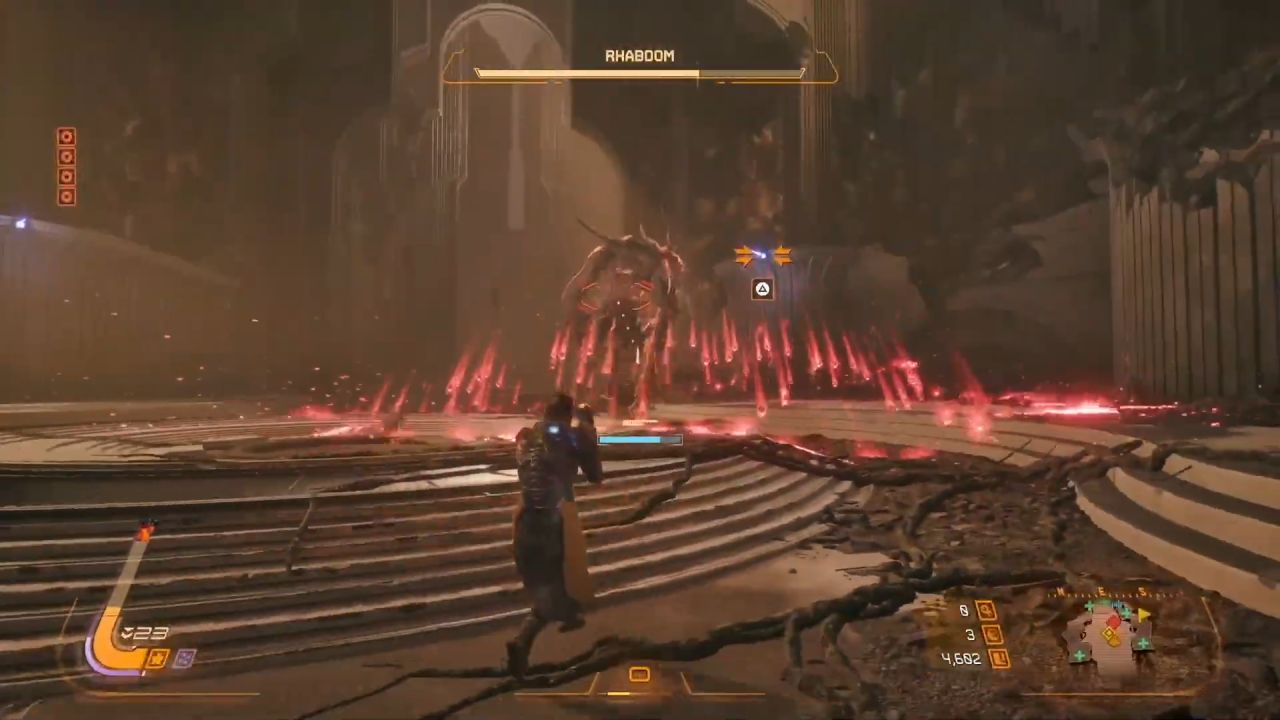
Rhabdom pressures a moving player with lunges and projectile volleys that reward abrupt grapple-based course changes. The encounter layers several threats around motion prediction; the diagram isolates one forecast and one non-homing projectile.
Found an inaccuracy or have a suggestion for this page? Propose an edit on GitHub