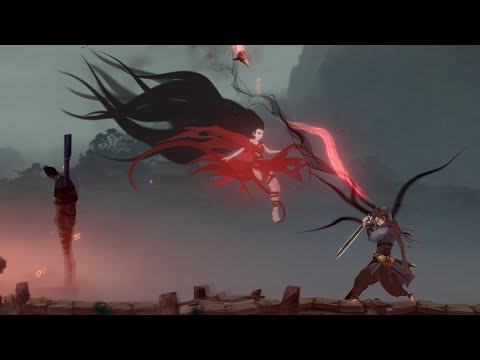
A posture stagger gauge converts sustained pressure into a temporary critical state instead of ordinary health damage. The boss can recover when pressure stops, but a full break creates a bounded opening; phase progress occurs only when the player performs the authored finisher, so buildup, break, and reward remain distinct decisions.
Build posture and expose its recovery ruleTavi's first sword contact adds 32 posture at 0.72 s. A deliberate pause after 1.02 s lets the gauge fall from 32 to 18, making recovery visible before two deflects and one strike rebuild pressure. Kern's health does not move during this setup.
Tavi's first sword contact adds 32 posture at 0.72 s. A deliberate pause after 1.02 s lets the gauge fall from 32 to 18, making recovery visible before two deflects and one strike rebuild pressure. Kern's health does not move during this setup.
Autoplay is disabled by reduced motion. Scrub across 0.72, 1.02, 1.42, 1.72, 2.12, 2.62, 2.82, 3.46, 3.88, and 5.20 seconds to inspect gain, recovery, renewed pressure, break, eligibility, consumption, close, and reset.
Implementation checklist
Define posture gain by action, recovery delay and rate, health coupling, break threshold, overfill policy, critical-ready duration, finisher eligibility and reach, input buffering, interruption, phase token consumption, reset rules, multiplayer ownership, accessibility signals, and telemetry that proves each break grants at most one critical result.
Core checks
Three questions for the mechanic
Which actions create posture pressure, and how does it recover?
Assign posture values to specific authored events—clean attacks, deflects, guard damage, weak-point hits, or positional counters—rather than deriving it invisibly from all damage. Choose a recovery delay, rate, and vitality relationship, then show both gain and loss. A short pause should demonstrate whether progress is banked, decays gradually, or resets by phase.
What exactly becomes true when the gauge breaks?
Create one authoritative break id when the threshold is crossed. Freeze or replace gauge recovery, enter a named critical-ready state, expose the eligible target and deadline, and define what interrupts it. Do not award health damage, a phase token, and a finisher from three unrelated collision callbacks.
How is the break consumed without duplicate progress?
Validate the current break id, player state, target, range, facing, and deadline when the finisher begins. Reserve the result, play the authored resolution, consume one token, and reject repeated inputs or network retries. If the deadline expires, restore the boss with a documented posture value and no critical reward.
Design mistakes
The gauge is only a second health bar
If every damaging hit adds the same amount and a full bar automatically removes health, posture introduces no new decision. Give pressure actions, recovery, and the critical consume step their own readable rules so the player chooses between maintaining posture and pursuing ordinary damage.
The break animation hides the usable window
A dramatic stagger without a shaped marker, reach cue, or closing signal makes the finisher feel inconsistent. Start the gameplay deadline at a documented moment, keep the target available for the promised duration, and show expiration independently of animation flair.
Tuning
Tune the attack
Use a ledger, not a floating sum
Record action id, source, posture delta, time, gauge before and after, recovery suppression, break id, critical deadline, claimant, consume time, phase token, and resulting health. Clamp once at the threshold and make one authority own break creation and consumption.
Tune pressure cadence against recovery
Measure the longest intended gap between successful pressure actions, then place recovery delay just beyond or within it according to desired mastery. Adjust gain, delay, decay rate, boss mobility, and counter opportunity together; a faster drain can erase otherwise valid defensive play.
Budget the critical approach separately
The break may occur at the edge of the arena or after knockback. Test that ordinary movement can reach the finisher target before expiry from every legal break position. If the finisher teleports or magnetizes the player, expose its range and collision rules instead of relying on hidden correction.
Test overlap and lifecycle boundaries
Simulate threshold crossing from multiple hits in one frame, damage-over-time, simultaneous players, boss interruption, phase transition, death, rollback, low frame rate, a finisher begun at the deadline, and repeated input. Each break must resolve to exactly one consume or one expiry.
Arena
The runes hold until their rhythm fails
Each clean contact drives light into a different seam of Kern's stone frame. When Tavi hesitates, the marks dim and knit together again. Sustained pressure finally aligns the whole inscription; the elemental kneels, one central rune opens, and a deliberate sword seal breaks the current layer before the quarry reforms it.
Player upgrades
Make maintenance and consumption readable at different tempos
Offer presets for recovery delay and critical duration, generous finisher buffering, optional target magnetism, strong break audio, vibration, captions for posture rising, recovering, broken, and expiring, and a segmented non-color gauge. In co-op, show the active break claimant while still allowing a documented handoff if that player cannot complete the finisher.
Do not confuse this with
A reversible pressure resource with an explicit consume step
Ordinary stun can follow one attack or timer without accumulated pressure. A weak point changes where damage is accepted. A phase gate advances when health or an objective crosses a threshold. A posture stagger gauge can recover before break and creates a temporary critical state whose authored finisher or critical action must separately convert pressure into encounter progress.