
Gatling Gull
Enter the GungeonGatling Gull's rapid shots wander within a spread toward a selected direction. This top-down example demonstrates a changing interior path, though the game does not draw Kern's explicit warning edges.
Limited spread varies a projectile's direction inside a fixed angular range rather than across the entire arena. Kern marks the cone before firing, so Tavi can walk beyond its outer edge; the three shots differ, but none may escape the promised bounds. The final shot passes before the boss settles and the player can re-enter.
Kern leans forward and outlines a 0.2-radian half-angle cone from one visible emitter. Tavi stands near its centerline.
Autoplay is disabled by the reduced-motion setting. Use the timeline slider to inspect the loop.
Tune the cone angle, emitter, projectile radius, release cadence, flight time, warning duration, and ordinary walking clearance as one contract.
Calculate both cone edges from the same emitter and axis used for every released direction. Lock the axis at commitment, and clamp each angle to plus or minus 0.2 radians. A decorative narrow warning over a wider random distribution would break the promise.
Release three single projectiles at 1.85, 2.4, and 2.95 seconds with distinct offsets inside the sector. Show their origins and travel; unlike a simultaneous fan, the exact interior lanes vary from shot to shot, while walking around the whole envelope remains reliable.
At Tavi's starting depth, the right edge is about 348 units from the left wall. Add the 18-unit projectile radius and Tavi's 24-unit radius: her center must get beyond about x=390. She reaches x=465 by 2.28 seconds, before the first shot reaches that depth.
If the projectile offset is sampled after drawing a smaller cone, the player can be hit while apparently outside danger. Derive rendering, sampling bounds, and collision from one spread specification.
Ending danger when the boss lowers its arm, instead of after the final flight, creates a false recovery cue. Keep the last shot live through its full 1.3-second flight.
The demonstration uses offsets of -0.15, +0.12, and -0.04 radians around a downward axis. All three sit inside plus or minus 0.2 radians. A seeded sequence makes scrubbing deterministic; a production random sampler must obey the same bound.
The emitter is at (280, 332), Tavi starts at (280, 660), and the right edge at y=660 is about x=347. At that depth, add both collision radii (18 + 24) before declaring an outside route safe.
Tavi walks 185 units laterally in 0.68 seconds after commitment. She crosses the conservative outer clearance before the first projectile's 1.3-second flight can reach her original depth; no invulnerability window is assumed.
The release spacing is 0.55 seconds and the third projectile expires at 4.25 seconds. Recover only after the complete barrage, so the visible final threat and safe label agree.
Kern's cracked palm gathers three pebbles while two floor-bound rune rays frame their possible paths. The stones break away one by one; none can slip outside the runes' fixed boundary.
Leave enough lateral arena space for the player and projectile radii beyond at least one edge. Faster dodges may cross between individual shots, but the baseline response should work with ordinary movement.
Projectile fan announces several fixed rays at once. Burst fire repeats shots along one ray. Limited spread allows successive shots to take different directions inside one committed sector; splitting projectile instead changes one projectile into several after launch.
Gatling Gull's rapid shots wander within a spread toward a selected direction. This top-down example demonstrates a changing interior path, though the game does not draw Kern's explicit warning edges.
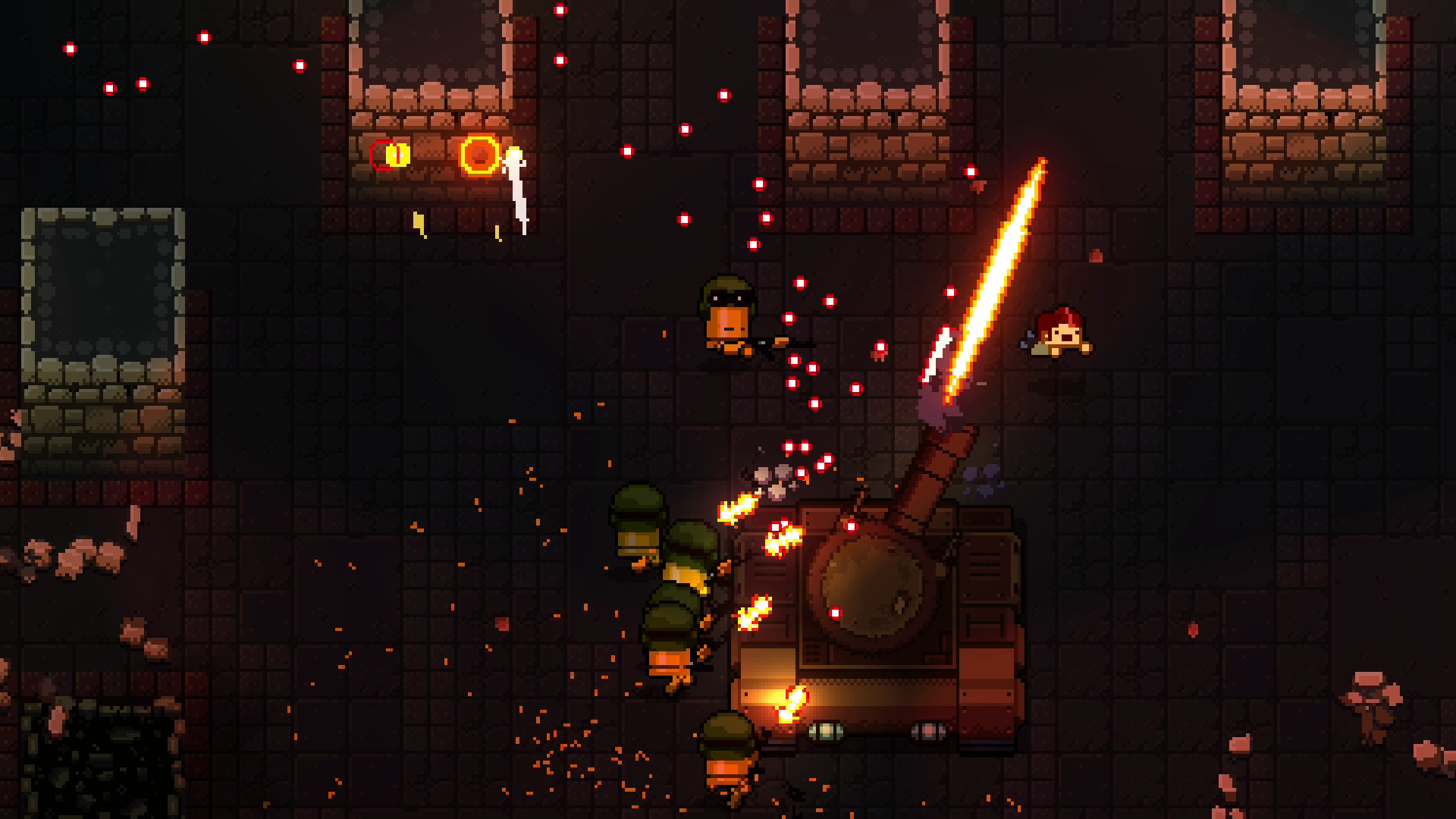
The corner turrets independently send short sequences vaguely toward the player while the tank continues its other actions. They provide a second bounded directional variation, but not Kern's isolated and explicitly outlined cone.
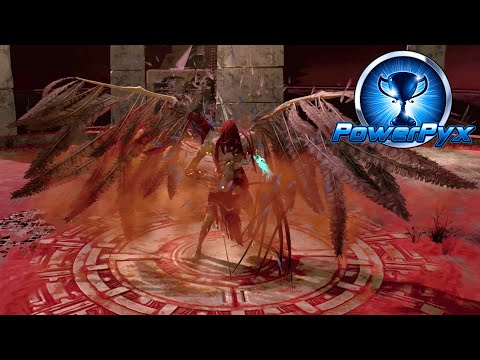
Ixion projects a cone of blue bullets during the opening phase. In 3D the readable boundary is a volumetric spread viewed from behind the player, not a flat pair of floor rays.
Found an inaccuracy or have a suggestion for this page? Propose an edit on GitHub