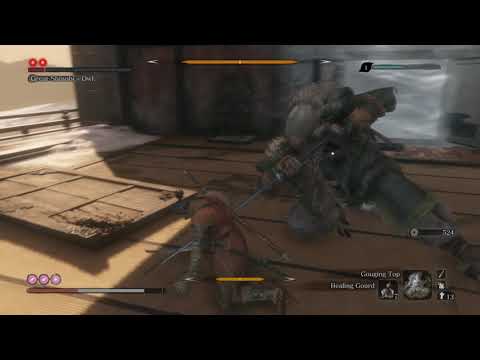
Kern raises a rune guard. Tavi's first sword strike meets it, producing a parry flash and a separate counter sweep. Later Kern takes the same stance again, but Tavi holds the sword back. With no trigger, the guard expires and an ordinary strike lands. The mechanic is a conditional response, not a permanent block or a reflected projectile.
Read the guardKern raises a marked rune guard from 0.62 s. Tavi's sword meets it at 1.88 s. The contact flash confirms a parry rather than boss damage.
Kern raises a marked rune guard from 0.62 s. Tavi's sword meets it at 1.88 s. The contact flash confirms a parry rather than boss damage.
Autoplay is disabled by the reduced-motion setting. Use the timeline slider to compare the triggered and untriggered guards.
Implementation checklist
Connect the guarded trigger, visible parry, independent counter threat, no-trigger timeout, and useful open window.
Core checks
Three questions for the mechanic
What exactly triggers the counter?
Define the accepted attack class and the guard's active interval. Here a sword hit at 1.88 s during the first guard is parried. The parry flash and sound must coincide with collision; the hit does not also deal boss damage. A guard with no incoming hit never starts the riposte.
Can the player read and clear the new threat?
Treat the counter as Kern's own attack, with its own wind-up, hitbox, damage, and recovery. Mark the fixed front lane after the parry, then start the 2.43–2.88 s sweep. Test Tavi's full body, not just the center point, at the slowest intended retreat speed.
What happens if the player waits?
Repeat the same guard from 3.48–4.48 s without a player strike. It expires without spawning a counter. Lower the rune visibly and allow a normal sword hit at 4.96 s. This timeout keeps patience useful and prevents an indefinite no-attack state.
Design mistakes
The counter strikes before the parry is legible
If contact instantly creates damage, the player cannot distinguish an attack-triggered response from an arbitrary boss swing. Give the parry a clear flash, then announce the separate counter hitbox before activation.
Every attack type is silently punished
Specify whether the stance reacts to sword, projectile, heavy, rear, or status attacks. A rule that changes by build needs a cue or safe discovery path; otherwise the guard appears inconsistent.
Tuning
Tune the attack
Separate the two event owners
Resolve the incoming strike first: parried or accepted. Only then schedule Kern's own counter. Do not reverse the player's attack object—that would be reflection—and do not leave the counter hitbox active for the whole guard.
Budget the response time
Measure parry recognition, counter wind-up, movement startup, and the distance the full player body must travel out of the sweep. A counter may be quick, but it cannot be an invisible punish for the player's committed input.
Make waiting productive
Time out the second guard without an incoming strike. The boss may spend a fixed recovery beat lowering the rune; the player can then re-enter with a normal sword hit. This is a design choice, not a requirement that every counter stance must expire.
Check both branches frame by frame
Inspect the 1.88 s parry, 2.43 s sweep start, 2.88 s sweep end, 4.48 s no-trigger timeout, and 4.96 s open hit. Seeking and reduced motion must preserve both branches and the same collision rule.
Arena
A rune that waits for steel
Kern's forward fist carries the guard rune. Contact makes it flare once, then the fist drives a short counter sweep. During the second guard the rune stays bright but never flares; when Kern lowers the arm, the exposed space is visible rather than inferred from a timer.
Player upgrades
Use the player's established attack verb
Tavi already has a sword, so the demonstration uses an ordinary sword hit as both the triggering input and the later useful attack. For other combat systems, choose one known attack class and make its interaction with the stance explicit before testing variations.
Do not confuse this with
A new boss move follows the trigger
Directional shield stops a hit while its facing remains guarded. Attack reflection turns the player's shot into a returning threat. Counter stance instead parries a qualifying hit and launches a separate boss-owned move; withholding the hit avoids that branch entirely.