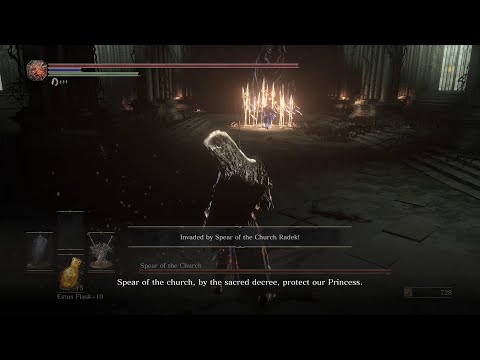
A player-controlled boss combines authored encounter structure with an opponent who can improvise. The boss role needs an explicit assignment flow, a bounded move set, readable telegraphs, encounter-owned health and rewards, and an AI fallback that preserves the same contract when matchmaking fails or the controller disconnects.

Open boss builder
Search for an eligible controller and assign the boss roleThe encounter opens in a matching state. At 0.70 s an eligible remote controller appears; at 1.20 s the crown token moves onto Kern and the role becomes authoritative. Tavi remains outside danger until the assignment is visible and complete.
Show control ownership without changing the fight's promises Kern stands above Tavi in a stone arena. A glowing crystal rises from a game controller to the crown above Kern, marking human control. Kern attacks down a broad lane as Tavi dodges sideways. When the controller disconnects, it dims, the crown changes to an AI mark, and the unchanged health bar shows that the fight continues. Boss Player

The encounter opens in a matching state. At 0.70 s an eligible remote controller appears; at 1.20 s the crown token moves onto Kern and the role becomes authoritative. Tavi remains outside danger until the assignment is visible and complete.

Implementation checklist

Define eligibility, consent, matchmaking timeout, role handoff, boss loadout normalization, legal actions, telegraph floors, health and resource authority, challenger scaling, latency compensation, disconnect and AFK detection, AI takeover, rematch rules, grief prevention, rewards, accessibility, privacy-safe telemetry, and deterministic tests for every transition.

Core checks

Three questions for the mechanic

  • Who may become the boss, and when does authority begin?

    Define opt-in, region, latency, progression, party, rank, repeat-opponent, and platform rules before searching. Time out into a known AI rather than holding the challenger at a door. Make one server-authoritative transition assign the controller, normalize their boss package, close late joins, announce the role to both sides, and start danger only after clients acknowledge the same state.

  • What can the human control without breaking the encounter?

    Give the controller meaningful choices inside authored constraints: select moves, aim within bounds, vary spacing, manage a boss resource, or coordinate limbs. Keep minimum startups, collision shapes, active windows, recovery, arena limits, health, phase gates, and forbidden exploits encounter-owned. Normalize imported builds or replace them with a role kit so matchmaking does not become an invisible difficulty roll.

  • How does the fight survive absence, latency, or abuse?

    Track heartbeat, input age, AFK duration, packet loss, illegal commands, surrender, and disconnect. On failure, stop accepting remote commands, freeze into a safe non-damaging beat, transfer the same state to AI, then resume without healing, repeating the intro, or duplicating rewards. Test reconnect policy, co-op scaling, host migration, rollback, grief stalls, intentional disconnects, and both victory orders.

Design mistakes

  • The human boss can erase telegraphs or bring an arbitrary build

    Unbounded cancel timing, animation swaps, status stacks, or imported equipment turn the authored fight into ordinary PvP with a boss health bar. Route every command through an encounter action graph, enforce startup and recovery on the authority, normalize stats, and reject commands that cannot be represented by the visible state.

  • Matchmaking or disconnect can stall progress

    A rare controller must not become a required external dependency. Set a short, communicated search budget, preload the fallback, preserve boss health and phase state during takeover, and make reward ownership idempotent. Simulate no candidate, late candidate, AFK, high latency, disconnect during startup and active frames, and both clients leaving.

Tuning

Tune the attack

  • Separate human expression from boss invariants

    Write two lists. Expression includes move choice, target selection, spacing, feints that still pay their startup, and resource timing. Invariants include telegraph floors, hit geometry, recovery, arena bounds, phase progression, health, and reward authority. The controller can surprise through choices, not by hiding the rules.

  • Normalize difficulty before scaling health

    Compare experienced and novice controllers, solo and co-op challengers, latency bands, controller input rates, and AI fallback. Prefer a bounded role kit, cooldown economy, poise or resistance budget, and challenger-count modifiers over copying a player's full build. Cap stall tools and healing so survival cannot replace engagement.

  • Make ownership and fallback visible but diegetic

    Use a crown, aura shape, nameplate label, arrival animation, announcer line, caption, and HUD state to show that another player has the boss role. When AI takes over, change the ownership marker without changing the boss silhouette or response vocabulary. Do not reveal private account data beyond the game's normal multiplayer identity.

  • Instrument the authority handoff

    Log search time, assignment source, normalized kit, command acceptance, telegraph start, authoritative hit, heartbeat age, takeover cause, transferred health and cooldowns, outcome, rematch, and reward grant. Automated tests should prove that one controller owns Kern at a time, illegal inputs do nothing, every damaging action was visibly announced, and each result pays once.

Arena

  • A distant will wakes inside Kern

    The quarry's crown searches the old rune network and finds another challenger. Its sigil settles above Kern, whose familiar stone body now waits, baits, and commits with a human rhythm—but every rune still lights before danger. When the link breaks, the crown dims to an amber machine-glyph and the elemental continues from the same cracked core.

Player upgrades

  • Keep the opponent human without making access depend on perfect networking

    Use opt-in matchmaking, a visible search timeout, input buffering, generous but fixed telegraph floors, captions for ownership and connection state, non-color icons, an AI fallback, and a complete offline path. Let players hide remote names, reduce social signals, or choose AI-only play without changing progression rewards.

Do not confuse this with

  • Authored asymmetric PvP, not an ordinary invasion or scripted mimic

    An invasion adds a hostile player to the world under general PvP rules. A player-controlled boss assigns that person the encounter's boss slot, health, move constraints, arena, phase gates, and rewards. A mimic or adaptive AI only imitates player behavior; here a real participant supplies decisions, while AI exists as a contract-compatible fallback.

Bosses that use this mechanic

Learn more

Found an inaccuracy or have a suggestion for this page? Propose an edit on GitHub